Electricity bills in Pakistan have increased sharply over the last few years, especially for households and businesses using heavy appliances, air conditioners, and solar systems without battery backup. Because of this, many people are now shifting toward net metering, commonly known as the green meter system, to reduce monthly electricity costs and earn credits from excess solar energy production.
Here, get an idea of how it works, the latest NEPRA regulations, installation process, charges, unit calculations, and how solar consumers can maximize savings with approved on-grid solar systems.
How Does Net Metering With Solar Work?
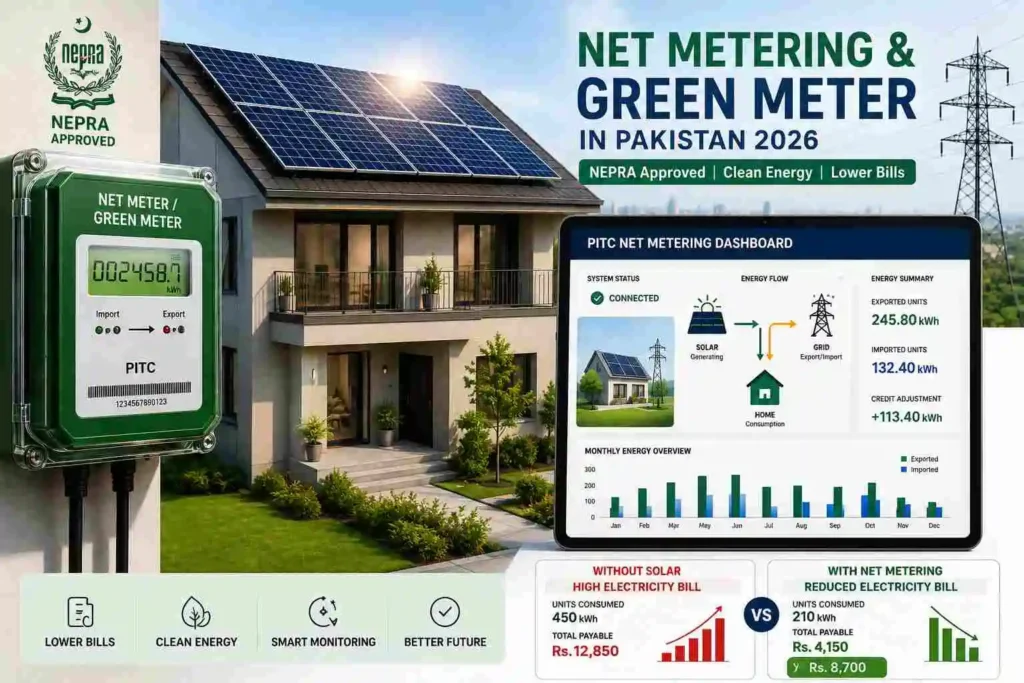
Net metering is the billing mechanism that lets you connect your solar PV system to the national grid through a Green Meter. It works by sending unused electricity back to the national grid. The exported units are credited against imported units, reducing your monthly electricity bill and helping homeowners and businesses save on energy costs.
NEPRA Net Metering Policy Change — Net Billing vs Net Metering:
NEPRA’s 2026 ARE Prosumer Regulations have replaced the old metering policy with a new net billing model for fresh solar applicants. Existing green meter consumers remain protected under their current agreements until contract expiry.
✅ Old System (Pre-2026 / Existing Consumers)
⚠ New System (Applications After Feb 9, 2026)
The Export Gap:
Under the net energy metering, exporting 100 electricity units at PKR 13 per unit earns a credit of PKR 1,300. However, importing 100 units from the national grid at an average tariff of PKR 35 per unit costs around PKR 3,500. Due to this substantial price difference, it’s a smart strategy to maximize your consumption during daylight hour.
Eligibility Criteria for Network Metering in Pakistan:
Required Documents for NEPRA Net Metering Eligibility:
Installer’s Role in Documentation:
As part of the solar connection process, an AEDB-approved installer prepares the essential technical documentation package, which commonly includes the SLD, inverter details, and anti-islanding protection certificates needed for regulatory verification.
⚠ Common Rejection Reasons for Prosumer Applications:
Distribution Transformer Capacity Issue:
In net zero metering, if your neighborhood transformer has reached its approved capacity limits with solar exports from your neighbors, your application will be delayed or rejected regardless of your paperwork. So, you must wait for a grid upgrade or transformer expansion before approval.
Solar Power Net Metering Application Process in Pakistan:
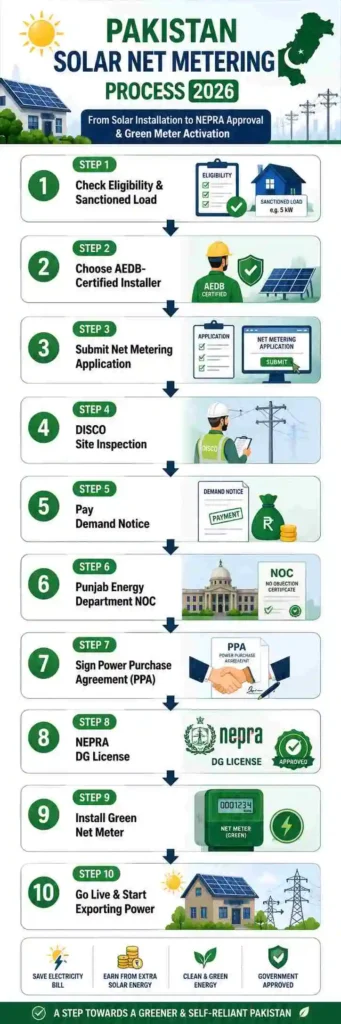
The process crosses three institutions: your solar installer, your recognized DISCO (like LESCO, FESCO, GEPCO, IESCO, MEPCO, HESCO, SEPCO, PESCO, QESCO, or K-Electric) and NEPRA. Every application follows a unique approval timeline, document requirement, and verification process that can lead to delays. Check this step by step breakdown:
Check Your Eligibility and Sanctioned Load:
⏱ Time: 1 day (just check your bill)
Before calling a solar company, check the above mentioned eligibility criteria and Sanctioned Load that is printed near the top of every bill.
- Minimum system size: 1 kW for residential consumers
- Maximum: Equal to your sanctioned load
Choose a Certified Installer for Solar Panel Installation:
⏱ Time: 2–5 days (selecting installer + initial survey)
Ensure your solar PV panels and inverter system are fully installed before submitting an application. LESCO will not approve a system that isn’t physically present. Critically, your installer must be Alternative Energy Development Board AEDB net metering certified. Using an uncertified installer means your application will be rejected. Similarly, the inverter must comply with anti-islanding protection standards (UL 1741 or IEC 62116). This is a safety requirement that LESCO checks during site inspection.
Prepare and Submit Application:
⏱ Time: 2–4 days (document gathering + submission)
Your AEDB-certified installer typically handles application preparation on your behalf and knows the exact format required. The application must reference SRO 892(I)/2015 (the governing regulation). Your vendor will compile the application, but you need to provide the personal and property documents. Missing even one document causes rejection. Your DISCO’s DG department does not send reminders, they simply mark the application incomplete and return it.
LESCO Online Portal: For LESCO consumers in Lahore, applications can now be submitted through enc.com.pk (the ENC portal). Upload all documents in JPG or PDF format under 300KB each. You’ll receive a Tracking ID to monitor your application status. Save it, as LESCO doesn’t send proactive status updates.
OR
Submit an application locally to your local Distribution Company (DISCO).
Site Inspection & Demand Notice:
⏱ Time: 7–15 working days (LESCO’s legal obligation, though often faster in 2026 with AMI-ERP integration)
After submission, the Distributed Generation department sends an inspection team to your premises, usually within 7–15 working days. They verify your solar system, check inverter specifications, confirm safety compliance, and assess meter location. If everything is in order, it issues a Demand Notice, an official payment challan for the bi directional metering and installation charges. The current cost of the LESCO-supplied bi-directional AMI Green Meter is approximately Rs. 42,000–52,000. Pay this demand notice promptly; delays here slow the entire process.
NOC Issuance by Punjab Energy Department:
⏱ Time: NOC stage typically takes 10–20 working days.
After the verification process is completed and the Demand Notice amount is paid, the wapda net metering solar file is routed to the Punjab Energy Department for statutory clearance. The issuance of a No Objection Certificate (NOC) serves as official confirmation that the solar PV system adheres to the technical, safety, and grid-integration regulations defined by NEPRA under SRO 892(I)/2015.
Signing the Agreement:
After the NOC, the local DISCO like LESCO prepared a Power Purchase Agreement PPA between you (now an Independent Power Producer) and LESCO. This agreement covers the duration (typically 3 years for new connections under 2026 rules), the buy-back rate for exported units, and billing terms. Read this agreement carefully before signing, particularly the buy-back rate and the conditions for contract renewal or termination.
Allotment of NEPRA Generation License:
⏱ Time: DG license now takes approximately 3–5 weeks from submission
The signed agreement is forwarded to NEPRA for verification and issuance of your Distributed Generation (DG) License. This license officially recognizes you as an Independent Power Producer and gives you the legal permission to generate and export electricity to the national grid.
As of April 2026, NEPRA introduced a mandatory licensing fee: Rs 1,000 per kW of system capacity. A 5 kW system costs Rs 5,000. A 10 kW system costs Rs 10,000. This fee did not exist before April 2026.
Install the Net Metering Meter:
⏱ Time: 3–7 days (after license, subject to meter availability)
Once the DG license is issued, LESCO installs a bidirectional AMI (Advanced Metering Infrastructure) meter, that tracks both the electricity you pull from the grid and the surplus solar you push back. From this day forward, your exported units are recorded and credited monthly against your imports.
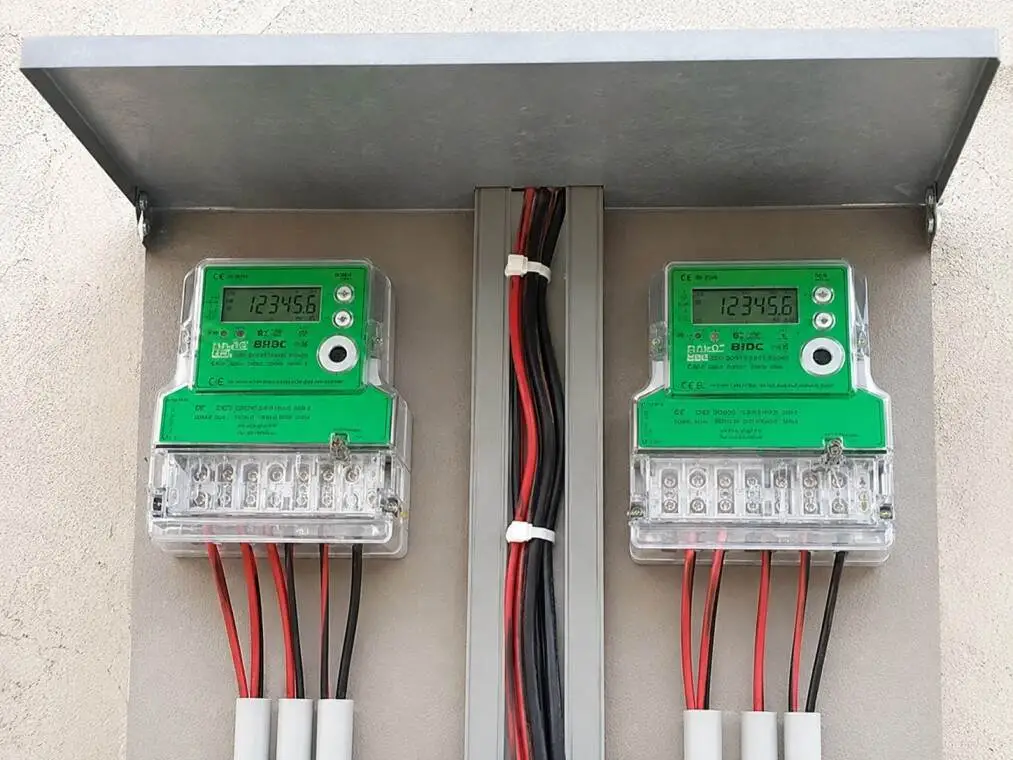
Green Meter Price: The cost of this meter is borne by you, the consumer, not LESCO. Expect to pay between Rs 18,000 and Rs 28,000, depending on your DISCO and the specific AMI meter model. Your installer will coordinate the installation with LESCO’s meter department.
Green Meter Name: The name stuck in public use because of its green color. However, this bidirectional meter had a different look than traditional single-direction metres.
Sign the Interconnection Agreement and Go Live:
⏱ Time: 1–2 days (signing + activation)
The final step is signing the Distributed Generation Interconnection Agreement with the electricity distribution company. This is your official contract that governs how exported electricity is credited, what the buyback rate is, and how long the arrangement runs. Once signed and the meter is activated, your system is live.
How is AMI Meter Reading Done?
Every month, the WAPDA green meter reader records four separate readings from your meter. These are identified by the numbers displayed on the meter itself: 6, 7, 8, and 9. Understanding what each number means helps you verify your bill is calculated correctly.
| Reading No. | What It Measures | Typical Value | Where It Affects Bill |
|---|---|---|---|
| 6 | Units Imported During Peak Hours | Positive (50–200 units) | Added to your peak-hour bill |
| 7 | Units Exported During Peak Hours | Usually zero (no sun at 6–10 PM) | Deducted from peak-hour bill |
| 8 | Units Imported During Off-Peak Hours | Positive (overnight, cloudy days) | Added to off-peak bill |
| 9 | Units Exported During Off-Peak Hours | Highest number (daytime solar) | Deducted from off-peak bill |
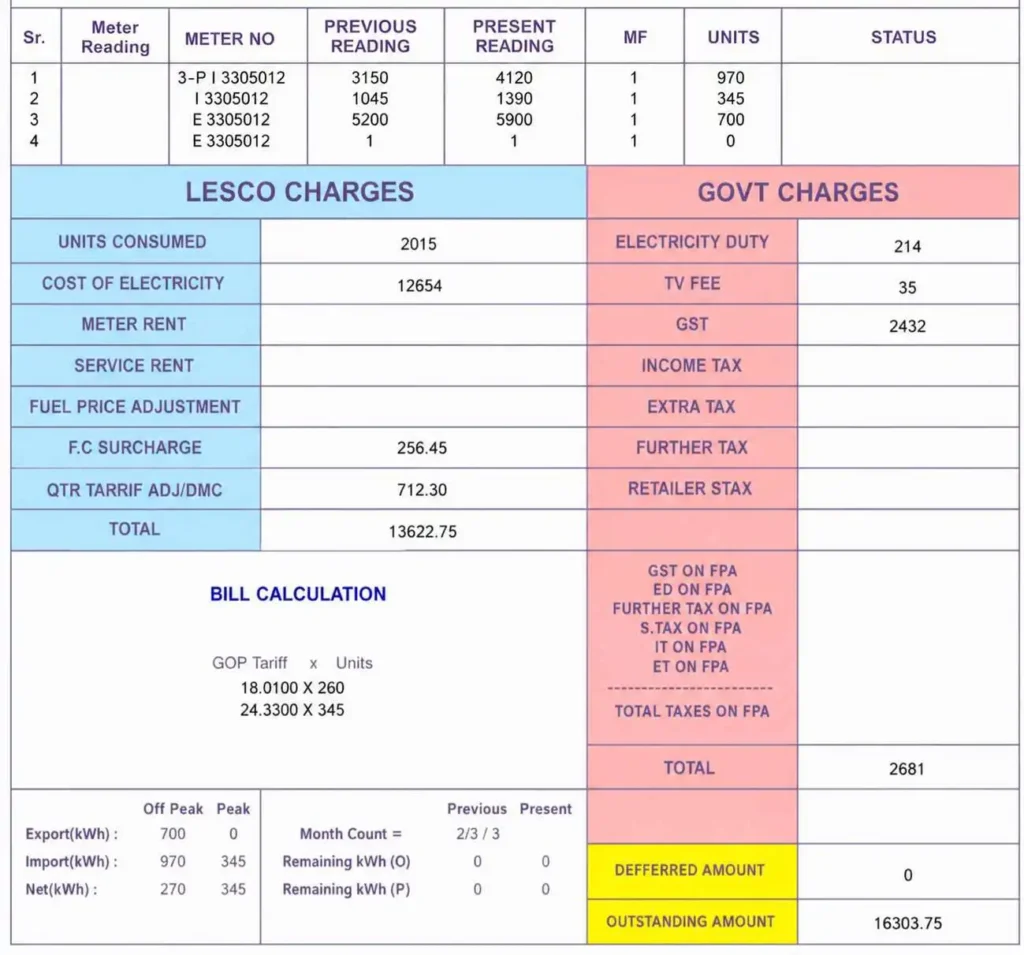
Under normal conditions, Reading 7 remains negligible or completely inactive because solar photovoltaic (PV) systems typically stop producing electricity after sunset unless surplus energy is supplied by a battery storage system. Reading 9 is typically your largest number, it represents all the solar power your system sent to the grid during the day.
Verification Tip: When your bill arrives, check that Reading 9 (off-peak exports) roughly matches what your solar inverter’s monitoring app shows for monthly production minus household consumption. For any unusual variation, request a manual meter inspection for timely bill correction.
How Your Net Meter Bill Is Calculated After the Green Meter?
Your LESCO bill after Green Meter installation has two components: peak-hour billing and off-peak hour billing. Each charge is assessed independently and then added together to determine your final net bill amount. This might confuse you, so let’s break it down clearly.
Peak Hours vs Off-Peak Hours:
- Peak Hours: In summer, 6:00 PM to 10:00 PM carry the highest electricity demand on LESCO’s grid. During peak hours, your solar panels are producing little or no power (the sun is setting or has set), so you’re drawing from either your battery bank or the grid.
- Off-Peak Hours: All remaining 20 hours — including the peak solar production hours during the day (10 AM to 4 PM). During off-peak hours, your panels are generating at maximum capacity, and surplus power flows to the grid.
Hour Type | Timing | Your Solar Output | Typical Flow Direction |
Peak | 6 PM – 10 PM | Low / Zero | Import from grid |
Off-Peak | 10 PM – 6 PM (all other hours) | High (daytime) | Export to grid |
Bill Calculation With a Real Example:
Let’s say in one month your meter records the following:
- Off-Peak Hours: Imported 80 units from grid | Exported 350 units to grid
- Peak Hours: Imported 120 units from grid | Exported 0 units to grid
Step 1 — Off-Peak Calculation (Rate: Rs. 14/unit approx.):
| Type | Units | Rate (Rs.) | Amount (Rs.) |
|---|---|---|---|
| Off-Peak Import | 80 | 14 | 1,120 |
| Off-Peak Export | 350 | 14 | 4,900 |
| Off-Peak Net | 80 − 350 = −270 | 14 | −3,780 (credit) |
Step 2 — Peak Hour Calculation (Rate: Rs. 24.33/unit approx.):
| Type | Units | Rate (Rs.) | Amount (Rs.) |
|---|---|---|---|
| Peak Import | 120 | 24.33 | 2,920 |
| Peak Export | 0 | 24.33 | 0 |
| Peak Net | 120 | 24.33 | 2,920 (payable) |
Step 3 — Net Bill:
| Peak Bill | Off-Peak Bill (Credit) | Net Bill |
|---|---|---|
| Rs. 2,920 | −Rs. 3,780 | −Rs. 860 (LESCO owes you) |
The net bill is −Rs. 860. In reverse metering, the negative sign means the surplus amount that will be adjusted in the next electricity bill; while the positive sign means the net payable amount to your electricity distribution company.
Remember: Fixed charges, GST, FPA, and other standard taxes still apply to your net meter bill. The Green Meter doesn’t eliminate these. So your actual invoice will include the net energy amount plus these standard levies. Use this Bill Calculator to estimate your total electricity charges.
⚠ What is Gross Metering?
In the gross metering mechanism, all your solar generations are exported to the grid, and you buy back everything you need at retail price. There have been rumors in Pakistan that the country has shifted to this mechanism. But these are just discussions, no official policy has replaced Net Billing.
Quarterly Arrangement:
Your DISCO operates net metering billing on quarterly cycles. The year is divided into four quarters, and peak-hour timings shift each quarter slightly to align with seasonal sunset changes. At the end of each quarter, if your account shows a negative net bill, you have two choices:
🔄 Carry Forward Credit:
- Adjust it against future bills.
- Automatic with quarterly billing cycle.
- No action required
💵 Cash Out Credit:
- Paid in cash at the approved solar panel metering purchase rate.
- Usually processed during annual or periodic settlements.
- Submit a written application to the local DISCO Sub-Division Office for credit settlement.
Most Practical Choice: Carry forward if you have bills in lower-production months (monsoon season or winter). Cash out only if your annual balance is consistently large and you have no remaining bills to offset.
Net Metering & Solar Financing Options in Pakistan:
By using bank-backed financing options, consumers can deploy a residential solar system and spread the cost over manageable installments.
Mostly these systems work on lease /RESCO (Renewable Energy Service Company) models in which you only pay for the electricity generated instead of purchasing the entire solar system.
Benefits of Net Metering:
Despite exporting surplus solar electricity or receive bill credits, net metering has these benefits:
Homeowners:
Businesses & Factories:
Environmental Benefits
Estimated Solar System Prices in Pakistan 2026:
| Solar System Size | Best For | Estimated Installed Price (PKR) |
|---|---|---|
| 3kW Solar System | Homes using up to 200 units/month | 350,000 – 450,000 |
| 5kW Solar System | Medium households | 550,000 – 750,000 |
| 10kW Solar System | Large homes & small offices | 950,000 – 1,300,000 |
| 30–100kW Commercial | Businesses & industries | 2,000,000+ |
Note: Actual solar panel prices vary based on equipment used.